Monday, October 29, 2018

Due Wednesday, October 31st - The Philosophy of Ayn Rand

Overview: We are going to embark on a journey through writing. This will require you to go out of your comfort zone and apply what you have learned through our class discussions of Anthem and Inequality for All. We will begin by reading some philosophy by Ayn Rand together. In her novels, Rand created characters that exemplified the ideals of Equality-2527, or Prometheus. These reading will also be used in the writing process, so please give this work your full attention.

Directions: We will read and explore these three pieces from the Ayn Rand institute together. When we finish you will be asked to use evidence from these texts. Take notes as we read and explore. In this blog space, please post three paragraphs one for each of the following readings.  Write about things you find interesting, connections to Anthem, and questions you have for me about Rand's philosophy.


Introduction to Objectivism
https://www.aynrand.org/ideas/overview


The Soul of an Individualist (From For the New Individualist) by Ayn Rand

https://campus.aynrand.org/works/1943/01/01/the-soul-of-an-individualist/page1


The Soul of the Collectivist (From For the New Individualist) by Ayn Rand

https://campus.aynrand.org/works/1943/01/01/the-soul-of-a-collectivist/page1

Friday, October 26, 2018

Due Monday, October 29th - Petrarchan Sonnets: A Study in Poetic Form

Overview:  The sonnet, as a poetic genre, began in Italy in the thirteenth century, and, under the later influence of the Italian poet Petrarch, became internationally popular. Petrarch established the basic form of the so-called Petrarchan sonnet Also called Italian sonnet: 14 lines divided into two clear parts, an opening octet (8 lines) and a closing sestet (6 lines) with a fixed rhyme scheme (abbaabba cdecde). Often the octet will pose a problem or paradox which the sestet will resolve. Petrarch also established the convention of the sonnet sequence as a series of love poems written by an adoring lover to an unattainable and unapproachable lady of unsurpassed beauty. The Petrarchan sonnet convention, in other words, established, not merely the form of the poem, but also the subject matter.


"Sonnet 292" from the Canzoniere
translated by Anthony Mortimer 


The eyes I spoke of once in words that burn,
the arms and hands and feet and lovely face
that took me from myself for such a space
of time and marked me out from other men;
the waving hair of unmixed gold that shone,
the smile that flashed with the angelic rays
that used to make this earth a paradise,
are now a little dust, all feeling gone;
and yet I live, grief and disdain to me,
left where the light I cherished never shows,
in fragile bark on the tempestuous sea.
Here let my loving song come to a close;
the vein of my accustomed art is dry,
and this, my lyre, turned at last to tears.


The eyes I spoke of with such warmth,
The arms and hands and feet and face
Which took me away from myself
And marked me out from other people;
The waving hair of pure shining gold,
And the flash of her angelic smile,
Which used to make a paradise on earth,
Are a little dust, that feels nothing.
And yet I live, for which I grieve and despise myself,
Left without the light I loved so much,
In a great storm on an unprotected raft.
Here let there be an end to my loving song:
The vein of my accustomed invention has run dry,
And my lyre is turned to tears.


Gli occhi di ch'io parlai sì caldamente,
et le braccia et le mani e i piedi e 'l viso,
che m'avean sì­ da me stesso diviso,
et fatto singular da l'altra gente;
le crespe chiome d'òr puro lucente
'l lampeggiar de l'angelico riso,
che solean fare in terra un paradiso,
poca polvere son, che nulla sente.
Et io pur vivo, onde mi doglio e sdegno,
rimaso senza 'l lume ch'amai tanto,
in gran fortuna e 'n disarmato legno.
Or sia qui fine al mio amoroso canto:
secca è la vena de l'usato ingegno,
et la cetera mia rivolta in pianto.


Directions:  Please choose a sonnet by Petrarch (see link below).  Cut and paste it into your post, and analyze it using the terminology we learned in class (see "The Poetry Cheet Sheet" below).  Most importantly, include a detailed personal analysis of the poem in your post. 


The Poetry Cheat Sheet 


Tone: This is the attitude of the speaker of the poem. You always have to consider the tone of the speaker even if you’re not specifically asked to analyze it. Tone relates to many of elements below. It’s a “big-picture” or “umbrella” concept. (You should have a “bank” of words in mind: angry, happy, carefree, bitter, sympathetic, sad, nostalgic, ironic, satirical, etc.)

Repetition: Poets often rely on repetition. This can be words, phrases, sounds, images, ideas. If a poet repeats something, it takes on more meaning.

Diction: This refers to words. What words does the poet use? Does he repeat any specific words? What connotation do the words have (positive, negative)?

Syntax/Structure: Do the sentences within the poem or stanzas have a recognizable structure? Does the structure or pattern change at a specific moment?

Imagery (sensory details): This refers to the images of the poem, especially those that appeal to many senses (sight, sound, taste, touch, smell).

Sounds: Sound is often conveyed in poetry. Look for rhyme and repetition, and things such as alliteration, consonance, and assonance (which are repetitions of specific types of sound).

Metaphors/Similes: Comparisons are often used to support imagery, but they can also be used to anchor a poem, to convey a poem’s main message. Any time a poet compares something to something else, you should take note of it.

Irony: This is HUGE in poetry. If something is said or happens that is unexpected, it’s ironic. If it’s sarcastic or satirical, it’s ironic. If you can recognize irony, you’re golden.

Allusion: This is a literary or historical reference. It is not as common on the AP exam, but you should know what it is and how it works.

Rhythm/Rhyme: This is covered with other elements above. This just refers to the recognizable pattern of a poem that gives it a sense of rhythm and flow.

Also:  Sestet (six line stanza), Octet (eight line stanza), Quatrain (four line stanza), couplet (two line stanza)

Wednesday, October 24, 2018

Due Friday, October 26th - "Anthem" and "Inequality for All"

Overview: We have come to the end of our initial analysis of Ayn Rand’s cautionary tale, Anthem as well as Robert Reich’s documentary Inequality of All. Each warns its audience of a problem staring them in the face, and how they are manipulated by a system. Ironically, both have traditionally been aligned with opposite sides of the political spectrum, Reich as a Democrat and Rand as a Republican. However, let’s look beyond party politics and think for ourselves. Both champion individual thought and reason. Both believe we need to go beyond groupthink and look at the facts. Thinking for yourself is key. Do not passively believe what is fed by the government, media outlets, school, peers, or other forms of hearsay. Even the work we did in this unit. Do not take my word. Study. Explore.

Directions: Finish reading Anthem by Ayn Rand and viewing Inequality for All. Next, answer ALL questions below in a blog response.  These study questions require your opinion, so it will be interesting to see the various ways your classmates view the material.  As always, use direct quotations in your response and return to the blog, read, and respond to your fellow classmates.


Chs. XI and XII

1. "I am. I think. I will" What is the significance of those words to you? Explain fully.

2. Explain what Equality means by the creed of corruption?

3. What did Equality learn about slavery and freedom? Why did men give up their freedom once they earned it?

4. Discuss any three of the precepts which Equality adopts as his guide to life? Do you see any similarity between them and the thoughts of Robert Reich in Inequality for All? Explore. You may have to write an essay comparing the two. 😏

5. Now that you finished both works, what kind of action could you take in order to be an authentic self? To make an impact on the economic crisis?  Again, who knows if this will be part of your final essay? 😉

Wednesday, October 17, 2018

Due Tuesday, October 23rd - "Anthem" Chs. VII-X (pages 68-93)

Overview: In this following section, Equality-2527 is about to share his discovery with the Home of the Scholars. You intimated to me in a previous class discussion that you do not think this will go over well. Much like the protagonist from “Allegory of a Cave,” there is a desire for the enlightened (or unconquered) to return to the prisoners and share the light of truth. Keep in mind what we learned from Inequality for All. Reich continues to enter the cave with the answers, but those in power wish to keep their shadows, their “candles” as the pinnacle of achievement. How will things turn out for Equality-2527?

Directions: Please read and review parts VII - X of Anthem by Ayn Rand, pages 68-93. Next, compose a blog response using four of the questions below (one for each chapter) as a guide and four direct quotations (one for each question/chapter) in your response. There are fewer questions, but the answers will vary depending on your personal opinions.  Remember to read each other’s comments and have a discussion.  I look forward to your responses.

Ch. VII
  • Why does Equality say, " We are old now, yet we were young this morning . . .?" 
  • When Ayn Rand writes, "for their eyes were still, and small, and evil," what does she really mean? How do you know this? 
Ch. VIII
  • What does Equality discover in the Forest, and why is he not concerned about being one of the Damned? 
Ch. IX
  • Explain the importance of the following statement: "There is no danger in solitude." 
Ch. X
  • What discovery do they find left over from the Unmentionable Times, and why does he keep writing?

Tuesday, October 16, 2018

Part II: Inequality for All

Overview:  We recently viewed the first part of the documentary, Inequality for All in which Robert Reich addresses this issue from the economic viewpoint and explains how it impacts all Americans.  You expressed your opening views on the film and made comparisons to Ayn Rand’s Anthem.

Directions:  Today, we will continue watching Inequality for All.  While you watch, please take notes.  In this blog space, jot down your continuing questions and impressions in three (3) paragraphs using direct evidence from the documentary.  Please use the list of questions from Robert Reich's website to help us begin our discussion.


Study Questions

  • Describe  a  moment  from this viewing section of  Inequality for All that  is  really  sticking  with  you  –  maybe  you  found  it  particularly  inspiring  or  particularly  troubling.    What  was  it  about  that  moment  that  is  so  memorable?
  • Reich  says,  “The  question  is  not  inequality  per  se;  the  question  is,  when  does  inequality  become  a  problem?”  In  your  own  words,  when  do  you  think  inequality  becomes  a  problem?  Do you see a problem now?  Explain how you see it around your community.
  • Reich  asks,  “Why  didn’t  the  nation  respond  to  the  Great  Regression  that  started  around  1980?  Why  didn’t  we  take  bold  steps  to  ensure  that  the  economy  would  continue  to  work  for  just  about  everyone?”  What  bold  steps  do  you  think  we  need  now?  What could you do?


Visit the website


Wednesday, October 10, 2018

Due Monday, October 15th - "Anthem" Ch. III - VI (pages 52-67)

Overview: In this following section, Equality-2527 makes an amazing discovery. Time alone allowed him to think, be creative, and now he wants to share his genius with society. Much like the protagonist from “The Allegory of a Cave” Equality found enlightenment. He stared directly into the sun, the symbolic light of truth. Now he will venture back into the cave (which ironically, is the other way around in the novel, as he leaves the cave to visit the council). Taking into account what we learned from Plato’s allegory, how do you think the elders will respond to his discovery? How will this impact Equality-2527?

Directions: Please read and review parts III-VI of Anthem by Ayn Rand, pages 52-67. Next, compose a blog response using four of the questions below (one for each chapter) as a guide and four direct quotations (one for each question/chapter) in your response. Remember to read each other’s comments and have a discussion. Note: If you see a number of your classmates writing about a particular question, please choose a different one. Let’s try to cover everything as a class! I look forward to your responses.


Ch III.
  • What has Equality discovered and what has he learned from it? 
  • Why does Equality think that the Council of Scholars is blind? 
  • A euphemism is defined as "the substitution of an agreeable or inoffensive expression for one that may offend or suggest something unpleasant; also : the expression so substituted" For example, Equality is not assigned a job; he is given a "Life Mandate". What other euphemisms have you discovered in this book? 
Ch. IV.
  • What name has Equality given to Liberty? Why? 
  • What name has Liberty given to Equality? Do you think that the name is appropriate? Why or why not? 
  • What is Liberty's Life Mandate? 

Ch. V.
  • What did Equality intend to do with his discovery? 
  • What is the World Council of Scholars and why is it significant? 
  • Why now does Equality feel the need to guard his tunnel? 
  • Why does Equality want, for the first time, to know what he looks like? 

Ch. VI

  • Why was Equality put in the Palace of Corrective Detention? 
  • How was he treated in the Palace? 
  • Why was he able to escape from the Palace, and why was it suddenly necessary to escape? 
  • Why did Equality not try to escape earlier? 
  • In this chapter, how does Equality refer to the pages that he has been writing?

Tuesday, October 9, 2018

Part I: Inequality for All

Overview:  We have been reading a novel about a man named Equality-2527.  If Ayn Rand's novel, Anthem is a cautionary tale about the dangers of conformity and government control, how do we take action in today's society?  In his documentary, Inequality for All Robert Reich addresses this issue from the economic viewpoint and explains how it impacts all Americans.

Directions:  Today, we will begin watching Inequality for All.  While you watch, please take notes.  In this blog space, jot down your initial questions and impressions in Three (3) paragraphs using direct evidence from the documentary.  Please use the list of questions from Robert Reich's website to help us begin our discussion. 

Study Questions

1)  Describe a moment from the film really sticking with you – maybe you found it particularly inspiring or particularly troubling. What was it about that moment that is so memorable?

2)  Imagine going home and telling a friend about this film. What would you say?

3)  What parts of the film were surprising or made you sit back and say, “Hmmm, I need to think more about that? Or, “Wow, I never thought about that.”


Visit the webiste:


View this brief explanation about the economic structure in America, which is similar to Reich's. 


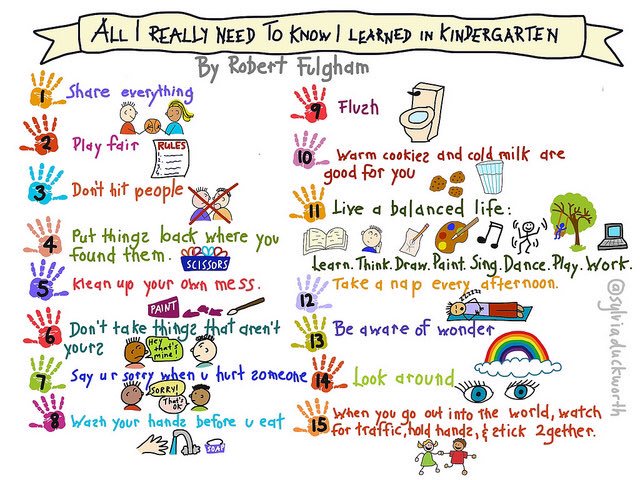
Due Friday, June 14th - All I Really Needed to Know I Learned in Mr. Pellerin's Freshmen English

Overview :  Go back to our first blog, and walk through the 2018-2019 school year.  Revisit the books we read and our class responses.  Look...