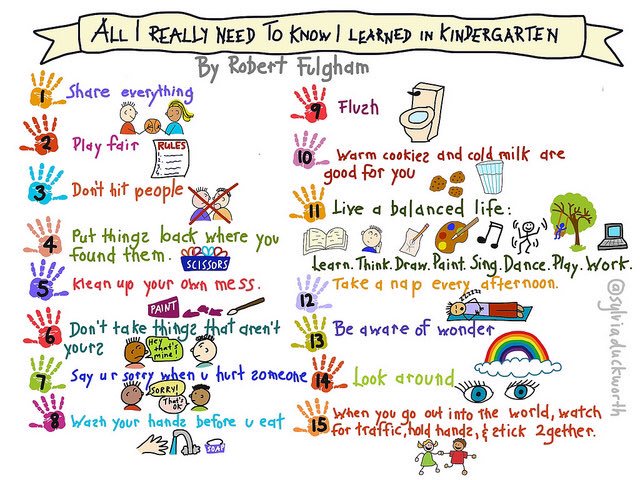
Overview: Go back to our first blog, and walk through the 2018-2019 school year. Revisit the books we read and our class responses. Look on Turnitin.com and review your past essays. What did you learn this year? What are the life lessons? Think about the "All I Really Needed to Know I Learned in Kindergarten" posters. Use that format here, and expound on how you will take the wisdom of Freshmen English with you into the great beyond. Please follow the format and rubric below:
"St. Crispin's Day" from Henry V by William Shakespeare
Romeo and Juliet (1968)
Romeo and Juliet (1996)
Lessons from Denice Yao Pomary
Oliver Twist by Charles Dickens
Oliver! (1968)
The Man Who Invented Christmas (2017)
Fahrenheit 451 by Ray Bradbury
"Burning a Book" by William Stafford
"Dover Beach" by Matthew Arnold
Minority Report (2002)
2) Select a cross-section of fiveof the works above, and make a list of the five substantial quotations that mirror life lessons you obtained from our class.
3) Using the bullet list, compose a fat paragraph for each one, using direct evidence from the text and other texts. These paragraphs should look like comprehensive blog responses or body paragraphs for a formal essay. Make personal connections to the characters and your own experiences. What will you do in your life now that you have been touched by these works?
4) Include a conclusion where you describe your overall experience in class. You may even choose a paraphrased quotation from Mr. P. as your heading. What books were your favorites? What were your favorite units? Lessons? Projects?
5) When all five paragraphs and your conclusion are complete, post them to the blog. Make sure to keep the quotations. It will most likely need to be spread out to 2-3 posts, as it will be a lot of words.
6) On exam day, we will spend half the class reading other's responses and responding. The second half we will have our final discussion and say our temporary goodbyes. We will also discuss the summer reading list and some suggestions by Mr. P.
Directions: Please finish read the novel and post your final thoughts on the novel in this blog space. Read and utilize the poem "Dover Beach" by Matthew Arnold in your response. Think about why Ray Bradbury would use this poem in his novel. How does it pertain the themes and end of the novel?
"Dover Beach"
By Matthew Arnold
The sea is calm tonight.
The tide is full, the moon lies fair
Upon the straits; on the French coast the light
Gleams and is gone; the cliffs of England stand,
Glimmering and vast, out in the tranquil bay.
Come to the window, sweet is the night-air!
Only, from the long line of spray
Where the sea meets the moon-blanched land,
Listen! you hear the grating roar
Of pebbles which the waves draw back, and fling,
At their return, up the high strand,
Begin, and cease, and then again begin,
With tremulous cadence slow, and bring
The eternal note of sadness in.
Sophocles long ago
Heard it on the Ægean, and it brought
Into his mind the turbid ebb and flow
Of human misery; we
Find also in the sound a thought,
Hearing it by this distant northern sea.
The Sea of Faith
Was once, too, at the full, and round earth’s shore
Lay like the folds of a bright girdle furled.
But now I only hear
Its melancholy, long, withdrawing roar,
Retreating, to the breath
Of the night-wind, down the vast edges drear
And naked shingles of the world.
Ah, love, let us be true
To one another! for the world, which seems
To lie before us like a land of dreams,
So various, so beautiful, so new,
Hath really neither joy, nor love, nor light,
Nor certitude, nor peace, nor help for pain;
And we are here as on a darkling plain
Swept with confused alarms of struggle and flight,
Where ignorant armies clash by night.
Directions: 1) Read Fahrenheit 451 by Ray Bradbury, "Part II: The Sieve and the Sand," pages 33-77. 2) In this blog space, answer at least 5 of the following questions using direct quotations/evidence from the text. We will use these study questions to have a class discussion on the material. I look forward to your responses. NOTE: The full text and audiobook can be found below the study questions in this post, for your convenience.
Study Questions (Please choose at least 5)
1. In the scene where Mildred and Montag read books together, what are their separate reactions?
2. What is the effect throughout sections I and II, of the bombers flying over?
3. Who is Professor Faber? Explain his significance.
4. Montag’s reaction to the commercial on the subway is a turning point in his life. How does he react and why?
5. What argument does Faber make for books? How do you feel about his comments?
6. What is the “small green metal object”? How does it tie into the plot.
7. What does the White Clown show lead you to believe about television programming in this society? How does it connect to today?
8. Why does Mrs. Phelps cry when Montag reads “Dover Beach”?
9. What is Montag’s destination at the end of section II? Why?
10. What predictions might you make about later events in the story?
Directions: 1) Read Fahrenheit 451 by Ray Bradbury, "Part I: The Hearth and the Salamander," pages 7-33. 2) In this blog space, answer at least 5 of the following questions using direct quotations/evidence from the text. We will use these study questions to have a class discussion on the material. I look forward to your responses. NOTE: The full text and audiobook can be found below the study questions in this post, for your convenience.
Study Questions (Please choose at least 5)
1. Describe the society (a fictional America) that Montag lives in. In what ways is it similar to, but more extreme than, our society? What signs are there that it is a “dystopia” (the opposite of a utopia, an ideal society)?
2. What makes Clarisse so special—so different from most people in her society? What qualities does Montag have that make him receptive to her influence?
3. Why do you think the mechanical hound has been programmed to react to Montag?
4. Why do you think the woman chooses to burn herself along with her books? Why does this have such a powerful effect on Montag—what does it mean to him?
5. What is the point of Bradbury’s description of the kind of television show that Mildred likes to watch (p. 44-46)? [“sound and fury, signifying nothing”—I’ll explain this quotation in class]
6. What is shocking and disturbing about the way Montag finds out what happened to Clarisse? What does this tell us about Mildred and about their society?
7. Why does Montag get “sick” and try to avoid going to work?
8. What does the revelation that Montag has so many books hidden in his home tell us about him? Why do Montag’s hands seem to have a mind of their own—what does this actually mean?
9. What is Beatty’s explanation for the current state of their society?
10. What do you think of Mildred’s claim that she is happy, and why? How do you define happiness? Is being happy always the most important goal of life?
11. What events trigger Montag’s transformation from aloof, unthinking fireman to passionate, philosophical rebel?
12. Find three examples of foreshadowing in Part 1.
13. Like Hemingway, Bradbury sometimes writes in an elliptical style, giving us bits of information from which we must infer what is happening, what the characters are thinking and feeling. Find one example of this in Part 1.
14. Choose one paragraph or passage from Part 1 that is an example of Bradbury’s unusual writing style (e.g. p. 17/18, p. 24) and interpret its meaning.
15. What predictions might you make about later events in the story?
a few pages glow a long time.
The cover goes first, then outer leaves
curling away, then spine and a scattering.
Truth, brittle and faint, burns easily,
its fire as hot as the fire lies make—
flame doesn’t care. You can usually find
a few charred words in the ashes.
And some books ought to burn, trying for character
but just faking it. More disturbing
than book ashes are whole libraries that no one
got around to writing—desolate
towns, miles of unthought in cities,
and the terrorized countryside where wild dogs
own anything that moves. If a book
isn’t written, no one needs to burn it—
ignorance can dance in the absence of fire.
So I’ve burned books. And there are many
I haven’t even written, and nobody has.
" And now, I said (Plato), let me show in a figure how far our nature is enlightened or unenlightened: --Behold! human beings living in a underground cave, which has a mouth open towards the light and reaching all along the cave; here they have been from their childhood, and have their legs and necks chained so that they cannot move, and can only see before them, being prevented by the chains from turning round their heads. Above and behind them a fire is blazing at a distance, and between the fire and the prisoners there is a raised way; and you will see, if you look, a low wall built along the way, like the screen which marionette players have in front of them, over which they show the puppets.
- I see (Glaucon).
And do you see, I said, men passing along the wall carrying all sorts of vessels, and statues and figures of animals made of wood and stone and various materials, which appear over the wall? Some of them are talking, others silent.
- You have shown me a strange image, and they are strange prisoners.
Like ourselves, I replied; and they see only their own shadows, or the shadows of one another, which the fire throws on the opposite wall of the cave?
- True, he said; how could they see anything but the shadows if they were never allowed to move their heads?
And of the objects which are being carried in like manner they would only see the shadows?
- Yes, he said.
And if they were able to converse with one another, would they not suppose that they were naming what was actually before them?
- Very true.
And suppose further that the prison had an echo which came from the other side, would they not be sure to fancy when one of the passers-by spoke that the voice which they heard came from the passing shadow?
- No question, he replied.
To them, I said, the truth would be literally nothing but the shadows of the images.
- That is certain.
And now look again, and see what will naturally follow if the prisoners are released and disabused of their error. At first, when any of them is liberated and compelled suddenly to stand up and turn his neck round and walk and look towards the light, he will suffer sharp pains; the glare will distress him, and he will be unable to see the realities of which in his former state he had seen the shadows; and then conceive some one saying to him, that what he saw before was an illusion, but that now, when he is approaching nearer to being and his eye is turned towards more real existence, he has a clearer vision, -what will be his reply? And you may further imagine that his instructor is pointing to the objects as they pass and requiring him to name them, will he not be perplexed? Will he not fancy that the shadows which he formerly saw are truer than the objects which are now shown to him?
- Far truer.
And if he is compelled to look straight at the light, will he not have a pain in his eyes which will make him turn away to take and take in the objects of vision which he can see, and which he will conceive to be in reality clearer than the things which are now being shown to him?
- That is true.
And suppose once more, that he is reluctantly dragged up a steep and rugged ascent, and held fast until he 's forced into the presence of the sun himself, is he not likely to be pained and irritated? When he approaches the light his eyes will be dazzled, and he will not be able to see anything at all of what are now called realities.
- Not all in a moment, he said.
He will require to grow accustomed to the sight of the upper world. And first he will see the shadows best, next the reflections of men and other objects in the water, and then the objects themselves; then he will gaze upon the light of the moon and the stars and the spangled heaven; and he will see the sky and the stars by night better than the sun or the light of the sun by day?
- Certainly.
Last of he will be able to see the sun, and not mere reflections of him in the water, but he will see him in his own proper place, and not in another; and he will contemplate him as he is.
- Certainly.
He will then proceed to argue that this is he who gives the season and the years, and is the guardian of all that is in the visible world, and in a certain way the cause of all things which he and his fellows have been accustomed to behold?
Clearly, he said, he would first see the sun and then reason about him. And when he remembered his old habitation, and the wisdom of the cave and his fellow-prisoners, do you not suppose that he would felicitate himself on the change, and pity them?
- Certainly, he would.
And if they were in the habit of conferring honors among themselves on those who were quickest to observe the passing shadows and to remark which of them went before, and which followed after, and which were together; and who were therefore best able to draw conclusions as to the future, do you think that he would care for such honors and glories, or envy the possessors of them? Would he not say with Homer, Better to be the poor servant of a poor master, and to endure anything, rather than think as they do and live after their manner?
- Yes, he said, I think that he would rather suffer anything than entertain these false notions and live in this miserable manner.
Imagine once more, I said, such a one coming suddenly out of the sun to be replaced in his old situation; would he not be certain to have his eyes full of darkness?
- To be sure, he said.
And if there were a contest, and he had to compete in measuring the shadows with the prisoners who had never moved out of the cave, while his sight was still weak, and before his eyes had become steady (and the time which would be needed to acquire this new habit of sight might be very considerable) would he not be ridiculous? Men would say of him that up he went and down he came without his eyes; and that it was better not even to think of ascending; and if any one tried to loose another and lead him up to the light, let them only catch the offender, and they would put him to death.
Directions: Choose one of the following prompts and compose an essay. Use direct quotations from the text (see link below for help). Your essay should have at least five paragraphs and be 3-5 pages in length with 1.5 spacing. Use the rubric below as a guide. Use the proper formatting (see link below for a reminder).
Oliver Twist Essay Prompts (Choose One)
Prompt 1. In literary works, cruelty often functions as a crucial motivation or a major social or political factor. Using Charles Dickens' Oliver Twist, write a well-developed essay analyzing how cruelty functions in the work as a whole (meaning, how does everything turn out by novel's end) and what the cruelty reveals about the perpetrator and/or victim. Do not merely summarize the plot.
Prompt 2. Many works of literature contain a character who intentionally deceives others. The character’s dishonesty may be intended either to help or to hurt. Such a character, for example, may choose to mislead others for personal safety, to spare someone’s feelings, or to carry out a crime. Using Oliver Twist by Charles Dickens, compose a well-written essay analyzing the motives for a character's deception and discuss how the deception contributes to the meaning of the work as a whole.
Prompt 3.Oliver Twist by Charles Dickens features characters whose origins are unusual or mysterious. Write an essay in which you analyze how these origins shape the character and that character’s relationships, and how the origins contribute to the meaning of the work as a whole. Prompt 4. In his 2004 novel Magic Seeds, V. S. Naipaul writes: “It is wrong to have an ideal view of the world. That’s where the mischief starts. That’s where everything starts unravelling.”
Oliver Twist by Charles Dickens is a novel which a character holds an “ideal view of the world.” Write an essay in which you analyze the character’s idealism and its positive or negative consequences. Explain how the author’s portrayal of this idealism illuminates the meaning of the work as a whole.
These essays offer a well-focused and persuasive analysis of the assigned prompt. Using apt and specific textual support, these essays fully explore the assigned prompt and demonstrate what it contributes to the meaning of the work as a whole. Although not without flaws, these essays make a strong case for their interpretation and discuss the literary work with significant insight and understanding. Generally, essays scored an A reveal more sophisticated analysis and more effective control of language than do essays scored an A-.
B
These essays offer a reasonable analysis of the assigned prompt, and what it contributes to the meaning of the work as a whole. These essays show insight and understanding, but the analysis is less thorough, less perceptive, and/or less specific in supporting detail than that of the A essays. Generally, essays scored a B+ present better developed analysis and more consistent command of the elements of effective composition than do essays scored a B or B-.
C
These essays respond to the assigned task with a plausible reading, but they tend to be superficial or underdeveloped in analysis. They often rely upon plot summary that contains some analysis, implicit or explicit. Although the writers attempt to discuss the assigned prompt and how the relationship contributes to the work as a whole, they may demonstrate a rather simplistic understanding of the work. The essays demonstrate adequate control of language, but they may lack effective organization and may be marred by surface errors.
D
These lower-half essays offer a less than thorough understanding of the task or a less than adequate treatment of it. They reflect an incomplete or over simplified understanding of the work, or they may fail to address the assigned prompt directly. They may not address or develop a response to how it contributes to the work as a whole, or they may rely on plot summary alone. Their assertions may be unsupported or even irrelevant. Often wordy, elliptical, or repetitious, these essays may lack control over the elements of composition. Essays scored a D- may contain significant misreading and demonstrate inept writing. F
Although these essays make some attempt to respond to the prompt, they compound the weaknesses of the papers in the D range. Often, they are unacceptably brief or are incoherent in presenting ideas. They may be poorly written on several counts and contain distracting errors in grammar and mechanics. The writer’s remarks are presented with little clarity, organization, or supporting evidence.
Test Format: 60 Multiple Choice - Section one consists of questions pertaining to plot, character analysis, symbolism, and structure. Section two offers two passages from other novels by Charles Dickens. You are to read the passages and answer questions. This will test your ability to read critically. Study!
Directions: Please read Charles Dickens' Oliver Twist, Chapters 41-end. Please compose a comprehensive blog using at least THREE of the chapters from the reading. Make it a cross section of the chapters, one from the beginning, middle, and end of the reading selection. You may discuss characterization, plot developments, make predictions, and/or ask questions. Your blog response must include your personal insights, as well as 3-4 direct quotations from the text to back-up your responses. Remember to engage with one another.
Overview: The poetry club would like to put together an AHS Literary Magazine.We are accepting submissions of poems,
artwork, and short fiction.We would
also like to include a section where students share their favorite poems with a brief
paragraph describing its significance for said student.We are also looking for any students who would like to be involved in
compiling and editing the book with us.There
will be informational meetings on Wednesday after school in room 201 with me.
Further, we are looking for anyone interested in
attending the LTAB poetry workshop Cypher at Emerson College on Saturday, May 4th
with Mr. Pellerin.It is an opportunity to
engage in poetry workshops with published authors and young people from
surrounding towns.Please see me for
details.
Directions: Please read Charles Dickens' Oliver Twist, Chapters 35-41. Please compose a comprehensive blog using at least THREE of the chapters from the reading. Make it a cross section of the chapters, one from the beginning, middle, and end of the reading selection. You may discuss characterization, plot developments, make predictions, and/or ask questions. Your blog response must include your personal insights, as well as 3-4 direct quotations from the text to back-up your responses. Remember to engage with one another.
Directions: Please read Charles Dickens' Oliver Twist, Chapters 26-34. Please compose a comprehensive blog using at least THREE of the chapters from the reading. Make it a cross section of the chapters, one from the beginning, middle, and end of the reading selection. You may discuss characterization, plot developments, make predictions, and/or ask questions. Your blog response must include your personal insights, as well as 3-4 direct quotations from the text to back-up your responses. Remember to engage with one another.
Directions: Please read Charles Dickens' Oliver Twist, Chapters 16- 25. Please compose a comprehensive blog using at least THREE of the chapters from the reading. Make it a cross section of the chapters, one from the beginning, middle, and end of the reading selection. You may discuss characterization, plot developments, make predictions, and/or ask questions. Your blog response must include your personal insights, as well as 3-4 direct quotations from the text to back-up your responses. Remember to engage with one another.
Directions: Please read Charles Dickens' Oliver Twist, Chapters XI - XV. Please compose a comprehensive blog using the questions below as a guide in your reflections. Your blog response must include your personal insights, as well as 3-4 direct quotations from the text to back-up your responses. Remember to engage with one another.
What is the most important piece of information that we learn in Chapter 12? 13? 14?
Directions: Read Chapters VI-X of Oliver Twist of Charles Dickens. For your blog responses, please consider the following questions:
1) What attracts poor people to go and live in a capital city like London? What are the advantages and disadvantages of such a move?
2) How did John Dawkins acquire the nickname, "The Artful Dodger?"
3) Select a major quotation to characterize each of the following characters and explain the reasons behind your choice: The Artful Dodger, Fagin, Mr. Brownlow, and Mr. Grimwig.
4) From Oliver’s from the point of view, how does he view each of the aforementioned characters?
5) Do you think it was better for Oliver to be with Fagin and his boys or with Mr. and Mrs. Sowerberry? Give reasons for your answer.
Directions: Please read Chapters 1-5 of Oliver Twist by Charles Dickens. In a blog response, consider the following characters: Mr. Bumble, Mrs. Mann, Mrs. Sowerberry, Noah Claypole. Choose one of the aforementioned characters and defend why you think he/she is the most cruel. Use direct quotations from the text in order to make you argument. Use evidence to prove why your choice is the most cruel, and use examples to prove why the others are not as cruel. Read your fellow classmates’ responses. Have a dialogue about their ideas. Finish your blog response with a guess as to what will happen to Oliver next. Again, use evidence from the text to back-up your theory.
Overview: Please view and take notes on the Charles Dickens documentary. Then read and study the biographical information below, as well as the list of major works by Charles Dickens. In this blog space, please comment on the material. What did you learn about Charles Dickens? What do you expect to see in his novel Oliver Twist? Be bold. Be brilliant.
Charles Dickens is much loved for his great contribution to classic
English literature. He was the quintessential Victorian author. His epic
stories, vivid characters and exhaustive depiction of contemporary life are
unforgettable.
His own story is one of rags to riches. He was born in
Portsmouth on 7 February 1812, to John and Elizabeth Dickens. The good fortune
of being sent to school at the age of nine was short-lived because his father,
inspiration for the character of Mr Micawber in 'David Copperfield', was
imprisoned for bad debt. The entire family, apart from Charles, were sent to
Marshalsea along with their patriarch. Charles was sent to work in Warren's
blacking factory and endured appalling conditions as well as loneliness and
despair. After three years he was returned to school, but the experience was never
forgotten and became fictionalized in two of his better-known novels 'David
Copperfield' and 'Great Expectations'.
Like many others, he began his literary career as a
journalist. His own father became a reporter and Charles began with the
journals 'The Mirror of Parliament' and 'The True Sun'. Then in 1833 he became
parliamentary journalist for The Morning Chronicle. With new contacts in the
press he was able to publish a series of sketches under the pseudonym 'Boz'. In
April 1836, he married Catherine Hogarth, daughter of George Hogarth who edited
'Sketches by Boz'. Within the same month came the publication of the highly
successful 'Pickwick Papers', and from that point on there was no looking back
for Dickens.
As well as a huge list of novels he published autobiography,
edited weekly periodicals including 'Household Words' and 'All Year Round',
wrote travel books and administered charitable organisations. He was also a
theatre enthusiast, wrote plays and performed before Queen Victoria in 1851.
His energy was inexhaustible and he spent much time abroad - for example
lecturing against slavery in the United States and touring Italy with
companions Augustus Egg and Wilkie Collins, a contemporary writer who inspired Dickens'
final unfinished novel 'The Mystery of Edwin Drood'.
He was estranged from his wife in 1858 after the birth of
their ten children, but maintained relations with his mistress, the actress
Ellen Ternan. He died of a stroke in 1870. He is buried at Westminster Abbey.
His Work
Wondering what books Dickens wrote? He was the author of 15
novels. (However, one of those is incomplete.) He also wrote short stories,
essays, articles and novellas.
The Pickwick Papers– 1836
The Pickwick Papers, also known as The Posthumous Papers of
the Pickwick Club, was the first novel of Charles Dickens.It was published by Chapman & Hall in monthly
installments from March of 1836 until November 1837. Dickens worked a very serious subject into comedic Pickwick
Papers, that of the injustice of the justice system.
Oliver Twist – 1837
The second novel of Charles Dickens was Oliver Twist. The
first edition had a longer title, Oliver Twist; or, The Parish Boy’s Progress. It was initially published in monthly installments that
began in February of 1837 and ended in April of 1839. The character Fagin was named after Bob Fagin, a fellow
employee that young Charles Dickens met when he worked at a blacking factory.
Nicholas Nickleby – 1838
The first installment of Nicholas Nickleby was published in
March 31, 1838 and the last installment was published in October 1, 1839. Dickens’s mother, Elizabeth Dickens, was the model for the
always-confused Mrs. Nickleby. Luckily for Charles she didn’t recognize herself
in the character. In fact, she asked someone if they “really believed there
ever was such a woman”.
The Old Curiosity Shop – 1840
The Old Curiosity Shop was published in installments in the periodical,
Master Humphrey’s Clock. The first installment was printed in April of 1840 and
the last was printed in February of 1841. Dickens was traumatized by the death of the book’s
character, Little Nell. As he was writing the novel he felt as though he were
experiencing the death of one of his children. It also brought back painful
memories of the death of his sister-in-law, Mary Hogarth.
Barnaby Rudge – 1841
Barnaby Rudge was published in installments from February to
November of 1841. It appeared in the magazine Master Humphrey’s Clock. The historical novel is set during the Gordon Riots of 1780.
Martin Chuzzlewit – 1843
Martin Chuzzlewit was first published by Chapman & Hall
in installments that began in January of 1843 and ran through July of 1844. The novel was written after Dickens traveled to America in
1842. The trip left Dickens with a very unfavorable impression of the United
States.
Dombey and Son – 1846
Dombey and Son was first published in installments that
began in 1846 and ran through 1848. Dickens gave a reading of the first installment of Dombey to
some of his friends. It went very well and gave Dickens the idea of doing
public readings.
David Copperfield – 1849
David Copperfield, Dickens’s eighth novel, was first
published as a serial. The first installment was published in May of 1849. The
last installment was issued in November of 1850. David Copperfield held a special place in Dickens’s heart.
In the preface to the 1867 edition, Dickens wrote, “like many fond parents, I
have in my heart of hearts a favourite child. And his name is David
Copperfield.”
Bleak House – 1852
Bleak House was published in installments from March 1852
through September 1853. This novel has the distinction of being perhaps the only
work of classic literature featuring a character that dies by spontaneous
combustion.
Hard Times – 1854
The novel first appeared in Dickens’s Weekly periodical,
Household Words. Hard Times was published in installments that began in April
of 1854 and ran through August of 1854. Hard Times takes an unsympathetic look at Utilitarianism.
This no-nonsense movement relied heavily on statistics, rules and regulations.
Little Dorrit – 1855
Little Dorrit was published in installments from December of
1855 through June of 1857. The Marshalsea debtors’ prison plays a large part in Little
Dorrit. What very few people knew was that Dickens’s father had been sent to
Marshalsea for three months.
A Tale of Two Cities – 1859
The first chapters of A Tale of Two Cities appeared in print
in April of 1859. The last chapter was printed in November of that same year. A play, The Frozen Deep, was the inspiration for A Tale of
Two Cities. Not only did the play give Dickens the idea for A Tale of Two
Cities, it brought about lasting changes to Dickens’s life in the form of Ellen
Ternan.
Great Expectations – 1860
Great Expectations was initially published in All the Year
Round, a weekly periodical founded and owned by Charles Dickens. There were
nine monthly installments, running from December of 1860 until August 1861. In the novel Pip, like Dickens himself, dreams of becoming a
gentleman. However, Pip comes to realize that there is more to life than wealth
and station.
Our Mutual Friend – 1864
Our Mutual Friend is the last novel that Charles Dickens
completed before his death. An interesting feature of the novel is its focus on the
“dust” business.
The Mystery of Edwin Drood – 1870
The Mystery of Edwin Drood was the fifteenth novel of
Charles Dickens. Dickens was only halfway finished with the book when he died.
“If Music be the food of love, play on
Give me excess of it…”
Orsino from Twelfth Night (I,i,1-2)
Company Name: The Admirals Men were a theatre troupe in Shakespeare’s day. Give yourselves a name. Something that says, “Hey, we know our Shakespeare. Hire us, okay?”
Group 1: Peyton, Mitch, Gannon, Sophia, Evan
Group 2: Jayden, Lucas, Lucy, Julia, Renne, Abhi
Group 3: Drew, Ben, Sean, Davis, Frankie, James Timeline: Four Classes: Writing Script (2) Rehearsal (1) Performances (1)
Script: Ten-minute Shakespeare: We should see a script with 50% Shakespearean text and 50% popular music lyrics. You must choose a theme and express it in either a series of moments in the play or you can do a quick cross section of the major moments. You must, however, have a unified beginning and end for the piece.
Soundtrack: How will you incorporate music into the piece? Will you develop a pop music soundtrack to line-up with the performance? Remember, that we also need to hear the actors. Will you use a classic music backdrop? Whatever you do, MAKE SURE THAT THE MUSIC FITS WITH YOUR THEME AND OVERALL VISION. In other words, if you choose a hip hop soundtrack, that will certainly influence the performance and theme. It may also influence how you cut the script. Maybe lines from the play can be sung or performed in spoken word (It certainly was meant to be sung, in a sense). Will you go Glee or Moulin Rouge and sing a pop song at major intervals. KEY: TAKE PRE-EXISTING SONGS AND TURN THEM INTO DUETS. CHANGE AND TWEEK LYRICS TO FIT PURPOSE.
Rehearsing and Choreography: THIS IS WHAT I WILL ALSO BE THINKING ABOUT WHEN I GRADE YOUR FINAL PERFORMANCE. MOVE AROUND PEOPLE! I will help you during rehearsals. For the songs (at least) have the lines and cues memorized. All prose and Shakespearean verse should be memorized to help the performance flow. Also, make sure all costumes and sets are ready to go and easy to execute. Also, make sure you have the music cued up and ready to go. Rehearsals are key.
Performances. If you are sick or cannot make it, you need to make the necessary arrangements with your group and Mr. Pellerin. Treat this assignment with the same respect as an exam. If you leave your group high and dry on performance day with no phone call or explanation, expect an F on the assignment.
So, what do I hand in?
1. A final cut script with song lyrics to Turnitin.com
2. A timeline explaining what was accomplished, as well as a list of who did what and when.
3. An actual performance. No more than 10 minutes long.
NOTE: Use of class/homework time will be a huge factor in your grade!!!
LADY MONTAGUE
O, where is Romeo? Saw you him to-day?
Right glad I am he was not at this fray.
BENVOLIO
Madam, an hour before the worshipp'd sun
Peer'd forth the golden window of the east,
A troubled mind drave me to walk abroad;
Where, underneath the grove of sycamore
That westward rooteth from the city's side,
So early walking did I see your son:
Towards him I made, but he was ware of me
And stole into the covert of the wood:
I, measuring his affections by my own,
That most are busied when they're most alone,
Pursued my humour not pursuing his,
And gladly shunn'd who gladly fled from me.
MONTAGUE
He, his own affections' counsellor,
Is to himself--I will not say how true--
But to himself so secret and so close,
So far from sounding and discovery,
As is the bud bit with an envious worm,
Ere he can spread his sweet leaves to the air,
Or dedicate his beauty to the sun.
Could we but learn from whence his sorrows grow?
We would as willingly give cure as know.
Enter ROMEO
BENVOLIO
See, where he comes: so please you, step aside;
I'll know his grievance, or be much denied.
Exeunt MONTAGUE and LADY MONTAGUE
BENVOLIO
Good-morrow, cousin.
ROMEO
Is the day so young?
BENVOLIO
But new struck nine.
ROMEO
Ay me! Sad hours seem long.
Was that my father that went hence so fast?
BENVOLIO
It was. What sadness lengthens Romeo's hours?
ROMEO
Not having that, which, having, makes them short.
BENVOLIO
In love?
ROMEO
Out—
BENVOLIO
Of love?
ROMEO
Out of her favour, where I am in love.
BENVOLIO
With whom?
ROMEO
Rosaline and she'll not be hit
With Cupid's arrow; she hath Dian's wit.
BENVOLIO
Then she hath sworn that she will still live chaste?
ROMEO
She hath, and in that sparing makes huge waste -
BENVOLIO
Alas, that love, so gentle in his view,
Should be so tyrannous and rough in proof!
ROMEO
Alas, that love, whose view is muffled still,
Should, without eyes, see pathways to his will!
Where shall we dine?
O me! What fray was here?
Yet tell me not, for I have heard it all.
Here's much to do with hate, but more with love.
Why, then, O brawling love! O loving hate!
O any thing, of nothing first create!
O heavy lightness! serious vanity!
Mis-shapen chaos of well-seeming forms!
Feather of lead, bright smoke, cold fire,
sick health!
Still-waking sleep, that is not what it is!
This love feel I, that feel no love in this.
Dost thou not laugh?
BENVOLIO
No, coz, I rather weep.
ROMEO
Good heart, at what?
(Servant enters and hands Benvolio and invitation and exits)
BENVOLIO
At thy good heart's oppression.
Coz, I just obtained an invitation to a party
At this same ancient feast of Capulet's
Sups the fair Rosaline whom thou so lovest,
With all the admired beauties of Verona:
Go thither; and, with unattainted eye,
Compare her face with some that I shall show,
And I will make thee think thy swan a crow.
ROMEO
When the devout religion of mine eye
Maintains such falsehood, then turn tears to fires;
And these, who often drown'd could never die,
Transparent heretics, be burnt for liars!
One fairer than my love! the all-seeing sun
Ne'er saw her match since first the world begun.
BENVOLIO
Tut, you saw her fair, none else being by,
Herself poised with herself in either eye:
But in that crystal scales let there be weigh'd
Your lady's love against some other maid….
BENVOLIO begins singing “I Just Haven’t Met You Yet” by Michael Buble
BENVOLIO
I'm not surprised
Not everything lasts
You've broken your heart so many times
I stopped keeping track.
ROMEO
Talk myself in,
I talk myself out.
I get all worked up
Then I let myself down.
I tried so very hard not to lose it
BENVOLIO
You came up with a million excuses
ROMEO
I thought I thought of every possibility
BENVOLIO
And I know someday that it'll all turn out
She'll make you work so you can work to work it out
And I promise you kid that you'll give so much more than you get
You just haven't met Juliet
Mmmmm ....
BENVOLIO
You might have to wait
ROMEO
I'll never give up
BENVOLIO
I guess it's half timing
ROMEO
And the other half's luck
BENVOLIO
Wherever you are
ROMEO
Whenever it's right
BENVOLIO
She'll come out of nowhere and into your life
JULIET enters
ROMEO (to JULIET)
And I know that we can be so amazing
JULIET (to ROMEO)
And baby your love is gonna change me
ROMEO
And now I can see every possibility
Hmmmmm ......
ROMEO and JULIET holding hands and singing in unison
ROMEO and JULIET
And somehow I know that it'll all turn out
And you'll make me work so we can work to work it out
ROMEO
And I promise you kid I'll give so much more than I get
JULIET
You just haven't met me yet
ROMEO
They say all's fair
JULIET
In love and war
ROMEO
But I won't need to fight it
JULIET
We'll get it by it
ROMEO and JULIET
We'll be united
ROMEO and JULIET dance during the interlude
ROMEO
And I know that we can be so amazing
JULIET
And being in your life is gonna kill me
ROMEO
And now I can see every single possibility
Hmmm .....
JULIET exits
ROMEO
And someday I know it'll all turn out
BENVOLIO enters
And I'll work to work it out
BENVOLIO
Promise you kid
ROMEO
I'll give more than I get
Than I get, than I get, than I get!
MERCUTIO enters
BENVOLIO, ROMEO and MERCUTIO (Dancing like the Rockettes)
Oh you know it'll all turn out
And you'll make me work so we can work to work it out
And I promise you kid to give so much more than I get
Yeah I just haven't met Juliet
ROMEO at center stage
ROMEO
I just haven't met Juliet
Oh promise you kid
To give so much more than I get
MERCUTIO and BENVOLIO
I said love love love love love love love .....
ROMEO
I just haven't met Juliet.
MERCUTIO and BENVOLIO
I said love love love love love love love .....
ROMEO
I just haven't met Juliet!
BENVOLIO
So come with me, Romeo
That I will show you shining at this feast,
And she shall scant show well that now shows best.
ROMEO
I'll go along, no such sight to be shown,
But to rejoice in splendor of mine own.
Exeunt
Example Two: Then I defy you stars!
PROLOGUE
Two households, both alike in dignity,
In fair Verona, where we lay our scene,
From ancient grudge break to new mutiny,
Where civil blood makes civil hands unclean.
From forth the fatal loins of these two foes
A pair of star-cross'd lovers take their life;
Whose misadventured piteous overthrows
Do with their death bury their parents' strife.
The fearful passage of their death-mark'd love,
And the continuance of their parents' rage,
Which, but their children's end, nought could remove,
Is now the two hours' traffic of our stage;
The which if you with patient ears attend,
What here shall miss, our toil shall strive to mend.
Romeo enters with Mercutio and their entourage in masks
ROMEO
I dream'd a dream to-night.
MERCUTIO
And so did I.
ROMEO
Well, what was yours?
MERCUTIO
That dreamers often lie.
ROMEO
I fear, too early: for my mind misgives
Some consequence yet hanging in the stars
Shall bitterly begin his fearful date
With this night's revels and expire the term
Of a despised life closed in my breast
By some vile forfeit of untimely death.
But He, that hath the steerage of my course,
Direct my sail!
Bell tolls.
On, lusty gentlemen. They all exit but Romeo. Juliet enters.
ROMEO
O, she doth teach the torches to burn bright!
It seems she hangs upon the cheek of night
Like a rich jewel in an Ethiope's ear;
Beauty too rich for use, for earth too dear!
So shows a snowy dove trooping with crows,
As yonder lady o'er her fellows shows.
The measure done, I'll watch her place of stand,
And, touching hers, make blessed my rude hand.
Did my heart love till now? forswear it, sight!
For I ne'er saw true beauty till this night.
ROMEO
[To JULIET] If I profane with my unworthiest hand
This holy shrine, the gentle fine is this:
My lips, two blushing pilgrims, ready stand
To smooth that rough touch with a tender kiss.
JULIET
Good pilgrim, you do wrong your hand too much,
Which mannerly devotion shows in this;
For saints have hands that pilgrims' hands do touch,
And palm to palm is holy palmers' kiss.
ROMEO
Have not saints lips, and holy palmers too?
JULIET
Ay, pilgrim, lips that they must use in prayer.
ROMEO
O, then, dear saint, let lips do what hands do;
They pray, grant thou, lest faith turn to despair.
JULIET
Saints do not move, though grant for prayers' sake.
ROMEO
Then move not, while my prayer's effect I take.
Thus from my lips, by yours, my sin is purged.
JULIET
Then have my lips the sin that they have took.
ROMEO
Sin from thy lips? O trespass sweetly urged!
Give me my sin again.
JULIET
You kiss by the book.
BENVOLIO enters, whispers in ROMEO'S ear, and exits.
ROMEO
Is she a Capulet?
O dear account! my life is my foe's debt.
NURSE enters, whispers in JULIET"S ear, and exits.
JULIET
My only love sprung from my only hate!
Too early seen unknown, and known too late!
Prodigious birth of love it is to me,
That I must love a loathed enemy.
JULIET
O Romeo, Romeo! wherefore art thou Romeo?
Deny thy father and refuse thy name;
Or, if thou wilt not, be but sworn my love,
And I'll no longer be a Capulet.
Tis but thy name that is my enemy;
Thou art thyself, though not a Montague.
What's Montague? it is nor hand, nor foot,
Nor arm, nor face, nor any other part
Belonging to a man. O, be some other name!
What's in a name? that which we call a rose
By any other name would smell as sweet;
So Romeo would, were he not Romeo call'd,
Retain that dear perfection which he owes
Without that title. Romeo, doff thy name,
And for that name which is no part of thee
Take all myself.
ROMEO
I take thee at thy word:
Call me but love, and I'll be new baptized;
Henceforth I never will be Romeo.
JULIET
What man art thou that thus bescreen'd in night
So stumblest on my counsel?
ROMEO
By a name
I know not how to tell thee who I am:
My name, dear saint, is hateful to myself,
Because it is an enemy to thee;
Had I it written, I would tear the word.
JULIET
My ears have not yet drunk a hundred words
Of that tongue's utterance, yet I know the sound:
Art thou not Romeo and a Montague?
ROMEO
Neither, fair saint, if either thee dislike.
JULIET
How camest thou hither, tell me, and wherefore?
The orchard walls are high and hard to climb,
And the place death, considering who thou art,
If any of my kinsmen find thee here.
ROMEO
With love's light wings did I o'er-perch these walls;
For stony limits cannot hold love out,
And what love can do that dares love attempt;
Therefore thy kinsmen are no let to me.
JULIET
If they do see thee, they will murder thee.
ROMEO
Alack, there lies more peril in thine eye
Than twenty of their swords: look thou but sweet,
And I am proof against their enmity.
JULIET
I would not for the world they saw thee here.
ROMEO
I have night's cloak to hide me from their sight;
And but thou love me, let them find me here:
My life were better ended by their hate,
Than death prorogued, wanting of thy love.
JULIET
By whose direction found'st thou out this place?
ROMEO
By love, who first did prompt me to inquire;
He lent me counsel and I lent him eyes.
I am no pilot; yet, wert thou as far
As that vast shore wash'd with the farthest sea,
I would adventure for such merchandise.
JULIET
But our families will never conset to our love. It is impossible.
ROMEO begins singing to JULIET Rewrite the Stars from The Greatest Showman.
ROMEO
You know I want you
It's not a secret I try to hide
I know you want me
So don't keep saying our hands are tied
You claim it's not in the cards
Fate is pulling you miles away
And out of reach from me
But you're here in my heart
So who can stop me if I decide
That you're my destiny?
What if we rewrite the stars?
Say you were made to be mine
Nothing could keep us apart
You'd be the one I was meant to find
It's up to you, and it's up to me
No one can say what we get to be
So why don't we rewrite the stars?
Maybe the world could be ours
Tonight
JULIET
You think it's easy
You think I don't want to run to you
But there are mountains
And there are doors that we can't walk through
I know you're wondering why
Because we're able to be
Just you and me
Within these walls
But when we go outside
You're going to wake up and see that it was hopeless after all
No one can rewrite the stars
How can you say you'll be mine?
Everything keeps us apart
And I'm not the one you were meant to find
It's not up to you
It's not up to me
When everyone tells us what we can be
How can we rewrite the stars?
Say that the world can be ours
Tonight
TOGETHER
All I want is to fly with you
All I want is to fall with you
So just give me all of you
JULIET
It feels impossible (it's not impossible)
ROMEO
Is it impossible?
TOGETHER
Say that it's possible
How do we rewrite the stars?
Say you were made to be mine?
Nothing can keep us apart
'Cause you are the one I was meant to find
It's up to you
And it's up to me
No one can say what we get to be
And why don't we rewrite the stars?
Changing the world to be ours
JULIET
You know I want you
It's not a secret I try to hide
But I can't have you
We're bound to break and my hands are tied
JULIET turns to go
ROMEO
O, wilt thou leave me so unsatisfied
JULIET
What satisfaction canst thou have to-night?
ROMEO
The exchange of thy love's faithful vow for mine.
JULIET
I gave thee mine before thou didst request it:
And yet I would it were to give again.
ROMEO
Wouldst thou withdraw it? for what purpose, love?
JULIET
But to be frank, and give it thee again.
And yet I wish but for the thing I have:
My bounty is as boundless as the sea,
My love as deep; the more I give to thee,
The more I have, for both are infinite.
RUBRIC
D or F performances
Anything less than the C performances below
C performances
Complete script for Mr. Pellerin & each group member (no trips to copy machine)
Script contains:
Clear theme
Interesting story development
Pop music and Shakespearean text integrated
Performance of scripts, in hand, is moderately smooth. Just periodic stops for technical difficulties
Costumes
Performance with all members occurs on the assigned date
B performances have all the above and…
Script contains: Meaningfully theme – Nuanced and philosophical
Complex plot development
Songs are meaningful and well placed (though perhaps a bit long, and/or one “note” meanings)
Well chosen moments from the text – a strong cross section of the play
Performance is smooth. Though not memorized, the performers know the material inside and out. Choices about technology, blocking, costumes, and the like are thought out beforehand.
A performances have all the above and…
Script contains: Themes and concepts are thought provoking. Shows us multiple sides to the issues presented
Clear theme – Nuanced and philosophical – Goes beyond stereotypes to get at the heart of the matter
Complex plot development and seamlessly thread together as if this were an original play and not a Frankenstein monster of moments
Songs are meaningful, well placed and preformed with feeling
Well chosen – a Strong cross section of the play – Tight!
Script is nuanced. Every line is thoughtfully spliced and there is a definite beginning, middle and end to the performance.
Performance is smooth and choreography is fun and meaningful. All props and cues are hit. One or two members attempted to memorize parts. Members tried to use note cards.
Costumes and staging are thoughtfully planned ahead of time and a world is created