Wednesday, October 10, 2018

Due Monday, October 15th - "Anthem" Ch. III - VI (pages 52-67)

Overview: In this following section, Equality-2527 makes an amazing discovery. Time alone allowed him to think, be creative, and now he wants to share his genius with society. Much like the protagonist from “The Allegory of a Cave” Equality found enlightenment. He stared directly into the sun, the symbolic light of truth. Now he will venture back into the cave (which ironically, is the other way around in the novel, as he leaves the cave to visit the council). Taking into account what we learned from Plato’s allegory, how do you think the elders will respond to his discovery? How will this impact Equality-2527?

Directions: Please read and review parts III-VI of Anthem by Ayn Rand, pages 52-67. Next, compose a blog response using four of the questions below (one for each chapter) as a guide and four direct quotations (one for each question/chapter) in your response. Remember to read each other’s comments and have a discussion. Note: If you see a number of your classmates writing about a particular question, please choose a different one. Let’s try to cover everything as a class! I look forward to your responses.


Ch III.
  • What has Equality discovered and what has he learned from it? 
  • Why does Equality think that the Council of Scholars is blind? 
  • A euphemism is defined as "the substitution of an agreeable or inoffensive expression for one that may offend or suggest something unpleasant; also : the expression so substituted" For example, Equality is not assigned a job; he is given a "Life Mandate". What other euphemisms have you discovered in this book? 
Ch. IV.
  • What name has Equality given to Liberty? Why? 
  • What name has Liberty given to Equality? Do you think that the name is appropriate? Why or why not? 
  • What is Liberty's Life Mandate? 

Ch. V.
  • What did Equality intend to do with his discovery? 
  • What is the World Council of Scholars and why is it significant? 
  • Why now does Equality feel the need to guard his tunnel? 
  • Why does Equality want, for the first time, to know what he looks like? 

Ch. VI

  • Why was Equality put in the Palace of Corrective Detention? 
  • How was he treated in the Palace? 
  • Why was he able to escape from the Palace, and why was it suddenly necessary to escape? 
  • Why did Equality not try to escape earlier? 
  • In this chapter, how does Equality refer to the pages that he has been writing?

Tuesday, October 9, 2018

Part I: Inequality for All

Overview:  We have been reading a novel about a man named Equality-2527.  If Ayn Rand's novel, Anthem is a cautionary tale about the dangers of conformity and government control, how do we take action in today's society?  In his documentary, Inequality for All Robert Reich addresses this issue from the economic viewpoint and explains how it impacts all Americans.

Directions:  Today, we will begin watching Inequality for All.  While you watch, please take notes.  In this blog space, jot down your initial questions and impressions in Three (3) paragraphs using direct evidence from the documentary.  Please use the list of questions from Robert Reich's website to help us begin our discussion. 

Study Questions

1)  Describe a moment from the film really sticking with you – maybe you found it particularly inspiring or particularly troubling. What was it about that moment that is so memorable?

2)  Imagine going home and telling a friend about this film. What would you say?

3)  What parts of the film were surprising or made you sit back and say, “Hmmm, I need to think more about that? Or, “Wow, I never thought about that.”


Visit the webiste:


View this brief explanation about the economic structure in America, which is similar to Reich's. 


Friday, October 5, 2018

Due Tuesday, October 9th - "Anthem" by Ayn Rand - Part II (pages 38-51)

Overview: Many of you asked, “Where are the women in this society?" You will meet them in part II. Be thinking about the role of women in this society and make connections to the role of women in
our society and around the world today.

Directions: Please read and review part II of Anthem by Ayn Rand, pages 38-51. Next, compose a blog response using at 2-3 of the questions below as a guide and 2-3 direct quotations in your response. Remember to read each other’s comments and have a discussion. Note: If you see a number of your classmates writing about a particular question, please choose a different one. Lets try to cover everything as a class! I look forward to your responses.

  • What does Equality mean when he says, "They"? 
  • Who is Liberty and what does she do? 
  • What is a Transgression of Preference? How did Equality commit such a transgression or transgressions? 
  • What is the Time of Mating? Why does Equality think of being sent to the Palace of Mating as being a "shameful matter"? 
  • How are children raised in Equality's society? 
  • Why doesn't Liberty want Equality to be one of her brothers? 
  • Why does Equality care about Liberty's age?  
  • What is wrong with Equality's brothers? 
  • Why is Equality afraid of the Uncharted Forest? 
  • What are the Unmentionable Times? 
  • What is the punishment for speaking the Unspeakable Word? 


Tuesday, October 2, 2018

Designer DNA

Overview:  In Anthem, we witness a society in which the government wishes to control its population by training its citizens from birth.  What if they could control us before birth?  The novel is science fiction, but the following documentary is not.

Directions:  View the brief documentary Designer DNA from Explained.  Compose a blog response where you discuss: 1)  Direct parallels to Anthem and 2) Do you feel the benefits are worth the risks?  Why or why not?  Please feel free to explore this issue.  I look forward to your responses.

Friday, September 28, 2018

Due Tuesday, October 2nd - Read & Respond to "Anthem" by Ayn Rand - Part I, pages 18-37

Overview: In the first chapter of Anthem, Ayn Rand establishes the dystopian world of Equality 7-2521. Much like The Giver, it appears to be a utopia (or was meant to be) and the consequences prove to be much the opposite of the original intention.


Directions: Please read and review part I, pages 18-37. Next, compose a blog response using at least one of the questions below as a guide and 2-3 direct quotations in your response. Remember to read each other’s comments and have a discussion. I look forward to your responses.

  • Explain the book's title and why Ayn Rand chose it. 
  • What were Ayn Rand's "villains"? Explain. 
  • In what is Equality writing? (i.e., what format is he writing?) 
  • What is Equality's curse? 
  • What is ironic about the Social Meeting? 
  • Why are friends forbidden? 
  • Describe the government and institutions where Equality lives.

Wednesday, September 26, 2018

Introduction: "Anthem" by Ayn Rand

Overview:  Ayn Rand came of age during the ascendancy of collectivism across the globe — not only in communist Russia, from which she escaped in 1926, but also in fascist Italy, Nazi Germany, and to an alarming degree in her adopted homeland, America. Rand identified collectivism — the idea that individuals should be subjugated to the group and sacrificed for the common good — not only as a moral evil but as the essential cause of the political evils then engulfing the civilized world.

In the summer of 1937, Rand took a break from working on The Fountainhead to write the novelette called Anthem, a short, highly stylized tale of a future dystopia so saturated in collectivism that the word “I” has disappeared from the language.

First published in England in 1938, Anthem was rejected by collectivist-dominated American publishers in the 1930s — an American edition (slightly revised by Rand) did not appear until 1946.

Tuesday, September 25, 2018

Blog and Class Participation Criteria & Progress Reports

Attention: Progress reports will be coming out October 1st, so be sure to revisit any blogs you need to refine or compose. I will be posting your grades to Aspen.

Please see me if you need any assistance or have any questions. Below is the rubric I gave you the first day of class for your convenience.

Mr. P.

Blog and Class Participation Criteria 


Directions: This is your space to read and discuss ideas about the material we read in class. You will notice that these blog responses are intensive, but it will allow you to speak your mind and obtain immediate feedback. These homework assignments will count substantially, and the rubric below will help guide you. I will show some examples in class, and you are always free to discuss your work with me in class or after school.


Grading: On Aspen, you will find an assessment labeled “Blog and Class Participation.” Every two weeks, I will update your grade according to the rubric below. It may change as the term progresses. The key is to complete your work on a regular basis and participate in class. At the end of each term, you will receive a formal response to your work with written feedback.


A range has the following qualities:
  • All work is complete and on-time 
  • Contributes to class discussion daily; a leader 
  • Well-written work 
  • Personal voice is present 
  • Thoughtful, meaningful, and there is always evidence that the student read the text closely 
  • Responses do not merely agree but challenge fellow students to think critically 
  • At least 3-4 well chosen, nice framed, direct quotations from a text 
  • Responds to fellow classmates so that a dialogue ensues 
  • Takes risks 
  • Returns to add comments to have a conversation 


B range may exhibit some of the above qualities, BUT:
  • Work is completed, but late on occasion 
  • Contributes to class discussion regularly, but not every class 
  • Too formal, little personal engagement 
  • 1-2 direct quotations; may not be well chosen or framed 
  • A thinner response than the A range 
  • A super long technical response that could be more concise 


C range may exhibit some of the above qualities, BUT:
  • Some blogs are missing, or incomplete 
  • Contributes to class discussion on occasion 
  • Not aware of audience; single post and does not return to discussion 
  • Responds to the prompt in a general manner 
  • Repeats what someone else wrote, as the student obviously did not read through the other responses 
  • There is a voice, but little evidence that the student read closely 
  • There are no direct quotations; there are some concrete examples 

D and F range may exhibit some of the above qualities, BUT:
  • Many blogs missing on a regular basis 
  • Late blogs completed, but only after many are missing; completed in bunches after the fact 
  • Rarely contributes to class discussion and/or often late or absent 
  • Late responses that could be high quality but only completed to avoid a zero 
  • A few sentences and comments, but little to no analysis 
  • Does not return to discussion 
  • Little engagement 
  • Is openly cruel to a classmate 
  • Knowingly inappropriate

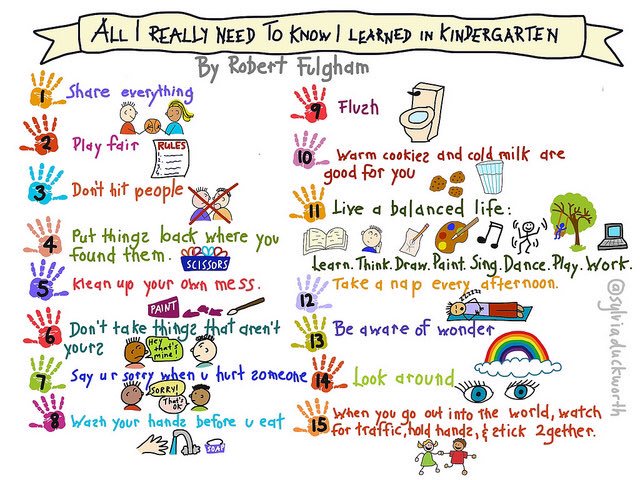
Due Friday, June 14th - All I Really Needed to Know I Learned in Mr. Pellerin's Freshmen English

Overview :  Go back to our first blog, and walk through the 2018-2019 school year.  Revisit the books we read and our class responses.  Look...