Monday, January 14, 2019

Due Wednesday, January 16th - Shakespeare of the Day - Henry V


Overview and class discussion: Please read the following background material and the speech from Henry V. Also, view the three performances of Henry V. Take note of the time period in which each was made. What was going on in world at the time? How did time impact the performances?

Homework:  Compose a blog response attending to the following:  1) How do the soldiers feel at the beginning of the scene.  2)  How does Shakespeare's King Henry appeal to his solider's emotions (pathos) using their belief in honor, 3) historical allusions, and 4) repetition?  5)  How do the soldiers feel now? Use five direct examples from the text, one for each question.


Background: Although Shakespeare penned this work nearly two hundred years after the Battle of Agincourt (1415), it remains the finest dramatic interpretation of what leadership meant to the men in the Middle Ages. Prior to the Battle, Henry V had led his English footmen across Northwestern France, seizing Calais and other cities in an attempt to win back holds in France that had once been in English possession and to claim the French crown through the obscure but powerful Salig Law. The French, aware of Henry's troops weaking condition because of their distance from England and the attacks of Dysentery that had plagued the dwindling band, moved between King Henry and Calais, the port he needed to reach in order to return to England. The troops followed Henry's band along the rivers, preventing their crossing and daring them to a battle they thought they could not win. The English knights fought on foot after the manner devised by Edward III. Archers were to be used in support, the English and Welsh longbows having established their credentials both at Crecy (1347) and at Poiters (1356). But here the French seemed to have sufficient numbers to deal with even this threat, and they refused to allow Henry pass, angered by the English seizure of the cities. Morale in the English line as they looked upon the overwhelming force of heavily armoured, highly skilled French knights must have been extremely low. King Henry, rising to the occasion, spoke words of encouragement that rallied the English troops and carried them to a victory. As a result of the victory the French Princess Catherine was betrothed to Henry V, and France and England were at peace for the remainder of Henry's short life. He perished of dysentery in 1422, but was survived by his son (Henry VI) and was buried at Westminster Abbey, close to the shrine of Edward the Confessor.

Although the speech below is a work of fiction, it is evocative of the spirit with which Henry--and all strong medieval kings--ruled through the strength of their convictions and by force of their personality.


GLOUCESTER
Where is the king?

BEDFORD
The king himself is rode to view their battle.

WESTMORELAND
Of fighting men they have full three score thousand.

EXETER
There's five to one; besides, they all are fresh.

SALISBURY
God's arm strike with us! 'tis a fearful odds.
God be wi' you, princes all; I'll to my charge:
If we no more meet till we meet in heaven,
Then, joyfully, my noble Lord of Bedford,
My dear Lord Gloucester, and my good Lord Exeter,
And my kind kinsman, warriors all, adieu!

BEDFORD
Farewell, good Salisbury; and good luck go with thee!

EXETER
Farewell, kind lord; fight valiantly to-day:
And yet I do thee wrong to mind thee of it,
For thou art framed of the firm truth of valour.

Exit SALISBURY

BEDFORD
He is full of valour as of kindness;
Princely in both.

Enter the KING

WESTMORELAND
O that we now had here
But one ten thousand of those men in England
That do no work to-day!

KING HENRY V
What's he that wishes so?
My cousin Westmoreland? No, my fair cousin:
If we are mark'd to die, we are enow
To do our country loss; and if to live,
The fewer men, the greater share of honour.
God's will! I pray thee, wish not one man more.
By Jove, I am not covetous for gold,
Nor care I who doth feed upon my cost;
It yearns me not if men my garments wear;
Such outward things dwell not in my desires:
But if it be a sin to covet honour,
I am the most offending soul alive.
No, faith, my coz, wish not a man from England:
God's peace! I would not lose so great an honour
As one man more, methinks, would share from me
For the best hope I have. O, do not wish one more!
Rather proclaim it, Westmoreland, through my host,
That he which hath no stomach to this fight,
Let him depart; his passport shall be made
And crowns for convoy put into his purse:
We would not die in that man's company
That fears his fellowship to die with us.
This day is called the feast of Crispian:
He that outlives this day, and comes safe home,
Will stand a tip-toe when the day is named,
And rouse him at the name of Crispian.
He that shall live this day, and see old age,
Will yearly on the vigil feast his neighbours,
And say 'To-morrow is Saint Crispian:'
Then will he strip his sleeve and show his scars.
And say 'These wounds I had on Crispin's day.'
Old men forget: yet all shall be forgot,
But he'll remember with advantages
What feats he did that day: then shall our names.
Familiar in his mouth as household words
Harry the king, Bedford and Exeter,
Warwick and Talbot, Salisbury and Gloucester,
Be in their flowing cups freshly remember'd.
This story shall the good man teach his son;
And Crispin Crispian shall ne'er go by,
From this day to the ending of the world,
But we in it shall be remember'd;
We few, we happy few, we band of brothers;
For he to-day that sheds his blood with me
Shall be my brother; be he ne'er so vile,
This day shall gentle his condition:
And gentlemen in England now a-bed
Shall think themselves accursed they were not here,
And hold their manhoods cheap whiles any speaks
That fought with us upon Saint Crispin's day.

Re-enter SALISBURY

SALISBURY
My sovereign lord, bestow yourself with speed:
The French are bravely in their battles set,
And will with all expedience charge on us.

KING HENRY V
All things are ready, if our minds be so.

WESTMORELAND
Perish the man whose mind is backward now!

KING HENRY V
Thou dost not wish more help from England, coz?

WESTMORELAND
God's will! my liege, would you and I alone,
Without more help, could fight this royal battle!

KING HENRY V
Why, now thou hast unwish'd five thousand men;
Which likes me better than to wish us one.
You know your places: God be with you all!


Persuasive techniques employed by King Henry:

PATHOS: Appeal to the emotions, values or prejudices of the audience.

LOGOS: Appeal to logic or reason.

ETHOS: Ask for the audience to believe or agree with the speaker based on their credibility/trustworthiness.

  • Acknowledge an opponent and/or their opposing viewpoint or argument
  • Cite evidence from credible authorities, make historical references or quote well-known texts
  • Mention an individual’s experience or tell a story from personal history
  • Compare/contrast events, things, ideas
  • Use figurative language, such as metaphors, similes, alliteration

Henry V - 1944 - Laurence Olivier


Henry V - 1988 - Kenneth Brannagh


Independence Day - 1996 - Bill Pullman


Thursday, January 10, 2019

Due Monday, January 14th - Modern Poetry Selections

Directions: Please read and respond to the two poems below. Think about your first gut reactions to each piece. Next, explore the authors’ use of literary devices and poetic form. Then, compare and contrast the poems in terms of both thematic elements and form. I look forward to your responses.

"A Barred Owl"
By Richard Wilbur


The warping night air having brought the boom
Of an owl’s voice into her darkened room,
We tell the wakened child that all she heard
Was an odd question from a forest bird,
Asking of us, if rightly listened to,
“Who cooks for you?” and then “Who cooks for you?”

Words, which can make our terrors bravely clear,
Can also thus domesticate a fear,
And send a small child back to sleep at night
Not listening for the sound of stealthy flight
Or dreaming of some small thing in a claw
Borne up to some dark branch and eaten raw.

Richard Wilbur, "A Barred Owl" from Mayflies: New Poems and Translations. Copyright © 2000 by Richard Wilbur.


"The History Teacher"
By Billy Collins


Trying to protect his student’s innocence
he told them the Ice Age was really just
the Chilly Age, a period of a million years
when everyone had to wear sweaters.

And the Stone Age became the Gravel Age,
named after the long driveways of the time.

The Spanish Inquisition was nothing more
than an outbreak of questions such as
“How far is it from here to Madrid?”
“What do you call the matador’s hat?”

The War of the Roses took place in a garden,
and the Enola Gay dropped one tiny atom 
on Japan.

The children would leave his classroom
for the playground and torment the weak
and the smart,
mussing up their hair and breaking their glasses,
while he gathered his notes and walked home
past flower beds and white picket fences,
wondering if they would believe that soldiers
in the Boer War told long, rambling stories
designed to make the enemy nod off.

“The History Teacher” from Questions About Angels Copyright ©1991 by Billy Collins

Literary Terms

1. Setting: The context in time and place in which the action of a story occurs. 2. Plot: The sequence of incidents or events of which a story is composed.
3. Subplot: A subordinate plot in a play.
4. Theme: The central idea of a literary work.
5. Point of view: The angle of vision from which a story is told. The four basic points of view are as follows:
Omniscient point of view: The author tells the story, using the third person, knowing all and free to tell us anything, including what the characters are thinking or feeling and why they act as they do.
Limited omniscient point of view: The author tells the story, using the third person, but is limited to a complete knowledge of one character in the story and tells us only what that one character thinks, feels, sees, or hears.
First person point of view: The story is told by one of its characters, using the first person.
Objective (or Dramatic) point of view: The author tells the story, using the third person, but is limited to reporting what the characters say or do; the author does not interpret their behavior or tell us their private thoughts or feelings.
6. Protagonist: The central character in a story.
7. Antagonist: Any force in a story that is in conflict with the protagonist. An antagonist may be another person, an aspect of the physical or social environment, or a destructive element in the protagonist's own nature.
8. Pun: A humorous use of a word to suggest another that sounds the same.
9. Parody: A comic imitation of a well-known person or literary work or style.
10. Narrator: In drama a character, found in some plays, who, speaking directly to the audience, introduces the action and provides a string of commentary between the dramatic scenes. The narrator may or may not be a major character in the action itself.
11. Style: The manner of writing or speaking or doing something (contrasted with the subject matter or the thing done).
12. Exposition: Expounding, and explanatory account of a plan or theory.
13. Climax: The turning point or high point in a plot.
14. Resolution (Denouement): That portion of a plot that reveals the final outcome of its conflicts or the solution of its mysteries.
15. Denotation: The basic definition or dictionary meaning of a word.
16. Connotation: What a word suggests beyond its basic definition; a word's overtones of meaning.
17. Personification: A figure of speech in which human attributes are given to an animal, an object, or a concept.
18. Allusion: A reference, explicit or implicit, to something in previous literature or history. (The term is reserved by some writers for implicit references only; but the distinction between the two kinds of reference is not always clear-cut.)
19. Metaphor: A figure of speech in which an implicit comparison is made between two things essentially unlike. It may take one of four forms: (1) that in which the literal term and the figurative term are both named; (2) that in which the literal term is named and the figurative term implied; (3) that in which the literal term is implied and the figurative term named; (4) that in which both the literal and the figurative terms are implied.
20. Simile: A figure of speech in which an explicit comparison is made between two things essentially unlike. The comparison is made explicit by the use of some such word or phrase as like, as, than, similar to, resembles, or seems.
21. Hyperbole (Overstatement): A figure of speech in which exaggeration is used in the service of truth.
22. Symbol (Symbolism): Some thing that means more than what it is; an object, person, situation, or action that in addition to its literal meaning suggests other meanings as well, a figure of speech which may be read both literally and figuratively.
23. Imagery: The representation through language of sense experience.
24. Run-on sentence: A line which has no natural speech pause at its end, allowing the sense to flow uninterruptedly into the succeeding line.
25. Sentence fragment: An incomplete sentence; lacking the quality of being complete in itself as an expression of thought.
26. Optimistic: Showing a tendency to take a hopeful view of things, or to expect that results will be good.
27. Pessimistic: Showing a tendency to take a gloomy view of things, or expect that results will be bad.
28. Genre: A particular kind or style of art or literature.
29. Thesis statement: A statement or theory put forward and supported by arguments.
30. Antithesis: Contrast of ideas emphasized by choice of words or by their arrangement.
31. Ambiguity: Having two or more possible meanings.
32. Prologue: An introduction to a poem or play etc; an act or event serving as an introduction to something.
33. Foil: A person or thing that contrasts strongly with another and therefore makes the other's qualities more obvious.
34. Local color: Details characteristic of a place or of the scene in which a novel etc. is set, added to make it seem more real.
35. Synopsis: A summary, a brief general survey.
36. Dialogue: The words spoken by characters in a play or story.
37. Foreshadow: To be a sign or (something that is to come).
38. Conflict: A clash of actions, desires, ideas, or goals in the plot of a story or drama. Conflict may exist between the main character and some external force, physical nature, society, or "fate"; or between the main character and some destructive element in his or her own nature.
39. Round (developing) character: Any of the persons involved in a story or play whose distinguishing moral qualities and personal traits are complex and many sided.
40. Static (flat character): A character who is the same sort of person at the end of a story as at the beginning.
41. Prose: Non-metrical language; the opposite of verse.
42. Mood: The feeling or tone conveyed by a literary work.
43. Satire: A kind of literature that ridicules human folly or vice with the purpose of bringing about reform or of keeping others from falling into similar folly or vice.
44. Flashback: A changing of the scene in a story to a scene at an earlier time.
45. Diction: A person's manner of uttering or pronouncing words.
46. Analogy: A partial likeness between two things that are compared.
47. Alliteration: The repetition at close intervals of the initial consonant sounds of accented syllables or important words (for example, map-moon, kill-code, preach-approve). Important words and accented syllables beginning with vowels may also be said to alliterate with each other inasmuch as they all have the same lack of an initial consonant sound (for example, "inebriate of air am I").
48. Rhyme: The repetition of the accented vowel sound and all succeeding sounds in important or importantly positioned words (for example, old-cold, vane-reign, court-report, order-recorder). The above definition applies to perfect or exact rhyme and assumes that the accented bowel sounds involved are preceded by differing consonant sounds. If the preceding consonant sound is the same (for example, manse-romance, style-stile), or if there is no preceding consonant sound in either word (for example, aisle-isle, alter-altar), or if the same word is repeated in the rhyming position (for example, hill-hill), the words are called identical rhymes. Both perfect rhymes and identical rhymes are to be distinguished form approximate or slant rhymes.

Tuesday, January 8, 2019

Exam Preparation

Exam Date: Wednesday, January 23rd - 8:00 - 9:30 am

Directions:  This will be a skill based exam.

Part I: Reading Skills. You will be asked to read an excerpt from a novel, answer 10 multiple-choice questions, and write about the piece intelligently.

Part II. Poetry. You will be asked to read a modern poem, answer five multiple-choice questions, and write about the piece intelligently.

Part III. You will compose a short essay, comparing and contrasting the novel excerpt and the poem from parts I and II.

Note:  Please know the following literary devices: metaphor, simile, imagery, personification, alliteration, hyperbole, tone, allusion, foreshadow, and dramatic irony.  If you do not remember them, please refer to our first poetry blog for definitions, or look them up.

Sunday, January 6, 2019

Due Wednesday, January 9th - Romeo & Juliet, Act I, Scenes ii & iii

Directions:  In small groups, assign roles and read Romeo & Juliet, Act I, scenes ii & iii.  Discuss what is being said.  Use the left hand margin as a guide.  Next, post a blog response, much like the last one we composed.  Include 1-2 major passages, and explain the meaning behind some of the major moments from the text.  How would you characterize Lord Capulet?  Paris?  How are Lady Capulet and the Nurse used as foils?  How does Dramatic Irony come into play in these two scenes?  Explore the possibilities.  Engage with each other.  Ask questions.  What would you like to discuss in class on Wednesday.  I look forward to your responses.


Wednesday, January 2, 2019

Due Monday, January 7th - Romeo & Juliet - Act I, scene i

Directions: Please reread Act I, scene i of Romeo and Juliet by William Shakespeare. Choose 1-2 major passages from the play and comment on the ideas, philosophy, and/or the motivations of the characters as well as the impact on the plot of the play. For example, what are the comedic elements in the play? How is Shakespeare using humor to prepare us for the tragedy about to ensue? How does Shakespeare use dramatic irony in the play? What is going on in the mind of Romeo? How does Shakespeare use foil characters? Tybalt and Benvolio?


Tuesday, January 1, 2019

Due Wednesday, January 2nd - Prologue

Directions:  Please listen to Mr. Pellerin recite the Prologue to Romeo & Juliet.  In this blog space, please post your initial thoughts.  Given what you learned in the documentary about how Shakespeare "broke the mold," what do you anticipate will be different about this tragedy compared with other plays?  What information does Shakespeare give us about the plot of the play in the prologue?  What do you notice about the form and structure? He seems to give away the ending.  What will happen in the end?  In your opinion, why would Shakespeare give away the ending?  This is a "live blog."  Engage with each other.

Prologue

Two households, both alike in dignity,
In fair Verona, where we lay our scene,
From ancient grudge break to new mutiny,
Where civil blood makes civil hands unclean.
From forth the fatal loins of these two foes
A pair of star-cross'd lovers take their life;
Whose misadventured piteous overthrows
Do with their death bury their parents' strife.
The fearful passage of their death-mark'd love,
And the continuance of their parents' rage,
Which, but their children's end, nought could remove,
Is now the two hours' traffic of our stage;
The which if you with patient ears attend,
What here shall miss, our toil shall strive to mend.

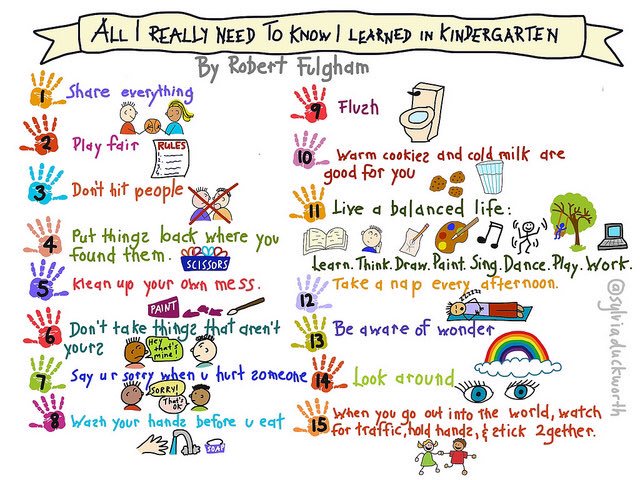
Due Friday, June 14th - All I Really Needed to Know I Learned in Mr. Pellerin's Freshmen English

Overview :  Go back to our first blog, and walk through the 2018-2019 school year.  Revisit the books we read and our class responses.  Look...